
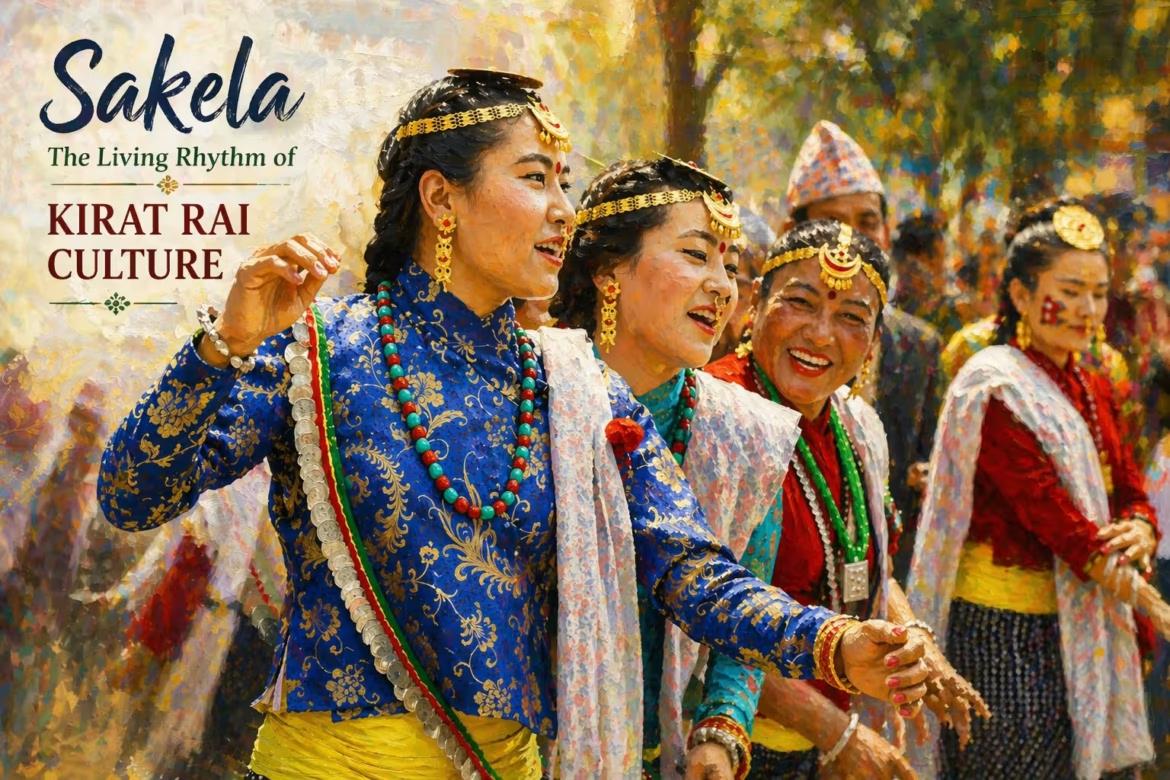
If you’ve ever walked past Tundikhel during certain times of the year, you might have noticed something beautiful unfolding—circles of people, young and old, dressed in vibrant traditional attire, moving in rhythm, singing, and celebrating together. It’s not just a dance. It’s a story, a belief, and a way of life.
Welcome to the world of Sakela, Ubhauli, and Udhauli—one of the most meaningful cultural expressions of the Kirat Rai community of Nepal.
Who Are the Kirat Rai?
The Kirat Rai are an indigenous ethnolinguistic group primarily from eastern Nepal, with roots that extend into parts of Northeast India. Historically, they are associated with the Kirat dynasty, believed to have ruled Nepal long before the rise of the Lichhavi Dynasty.
What makes the Kirat Rai community fascinating is its diversity. It consists of numerous sub-groups like Bantawa, Chamling, Kulung, Thulung, Yamphu, and many more—each with its own dialect and traditions. In fact, over 30 languages and dialects from the Tibeto-Burman family are spoken within this community.
Ubhauli & Udhauli: More Than Just Festivals
At the heart of Kirat Rai culture lies a deep connection with nature. This connection is beautifully reflected in two major festivals:
- Ubhauli (April/May – Baisakh)
- Udhauli (November/December – Mangsir)
The names themselves tell a story. “Ubho” means upward, and “Udho” means downward. These festivals are inspired by the migration patterns of birds and animals—especially the seasonal movement of geese between highlands and lowlands.
But it’s not just about nature—it’s also about survival and livelihood.
- During Udhauli, people traditionally moved downward for paddy plantation.
- During Ubhauli, they moved upward after harvesting crops.
Before both these agricultural phases, the Kirati people worship their deities Sumnima and Paruhang, praying for good harvests, protection from natural disasters, and overall well-being. Because of this, the festival is also known as Bhumi Puja—a tribute to the earth.
Sakela: The Dance That Tells Stories
At the center of these festivals is Sakela—a dance that goes far beyond performance.
The word Sakela itself comes from the Rai language, often associated with “Chandi Naach” (ritual dance). But what makes it unique is how it blends storytelling with movement.
The dance is performed in a large circle, guided by leaders called Sili Mopas, and accompanied by traditional instruments like drums, cymbals, and the binayo. Each step—or sili—represents something:
- Movements of birds and animals
- Hunting scenes
- Daily life activities
- The entire cycle of paddy farming—from sowing to harvesting
Even the rituals are symbolic. A priest, known as Nakchhong, performs offerings that include local wine, grains, and sometimes animal sacrifices. A sacred stone called Sakala is revealed during the ceremony, marking the beginning of the dance.
This is not just celebration—it’s a living archive of ancestral knowledge, passed down through rhythm and memory.
The Legend Behind Sakela
Like many ancient traditions, Sakela is deeply rooted in mythology.
According to Kirat belief, the dance began with the union of Sumnima and Paruhang. Paruhang, the sky god, fell in love with Sumnima, the earth goddess. After their marriage, he once left her for a long time, wandering across the universe—even meditating atop Mount Everest.
When he finally returned, Sumnima, filled with both anger and longing, gave him a mystical garland called buti, which made him confess everything truthfully. His honesty restored their bond, and Sumnima danced with joy.
That joyful dance, as believed, became the origin of Sakela.
There’s also another layer—the Mundhum, the ancient oral scripture of the Kirat people. It narrates how their ancestors journeyed from the great river (Khuwalung) through valleys like Arun, Dudh Koshi, and Sun Koshi, eventually settling in eastern Nepal. During Sakela, these stories are retold—not just through words, but through dance.
Sakela Today: Culture Beyond Borders
Times have changed. Many from the Kirat Rai community now live in cities or abroad, far from the fields and forests their ancestors depended on.
Yet, the spirit of Sakela remains strong.
Today, Sakela is celebrated not just in Nepal, but across the world—in places like:
- Sikkim
- Darjeeling
- Hong Kong
- United Kingdom
- Australia
- United States
For many, especially the younger generation, it has become a way to reconnect—with identity, roots, and community.
But if you truly want to feel its essence, you have to experience it in the eastern hills of Nepal—where the air, the land, and the people still carry its original rhythm.
Why This Culture Matters
In a world that’s constantly moving forward, traditions like Sakela remind us to look back—not to stay there, but to understand where we come from.
For travelers, this is more than just a festival—it’s an invitation. An invitation to witness a culture that dances its history, sings its beliefs, and celebrates life in its purest form.

Leave a Reply